

Latest Weekly News
110V vs 240V vs 415V Extension Leads: Which Voltage Do You Need?

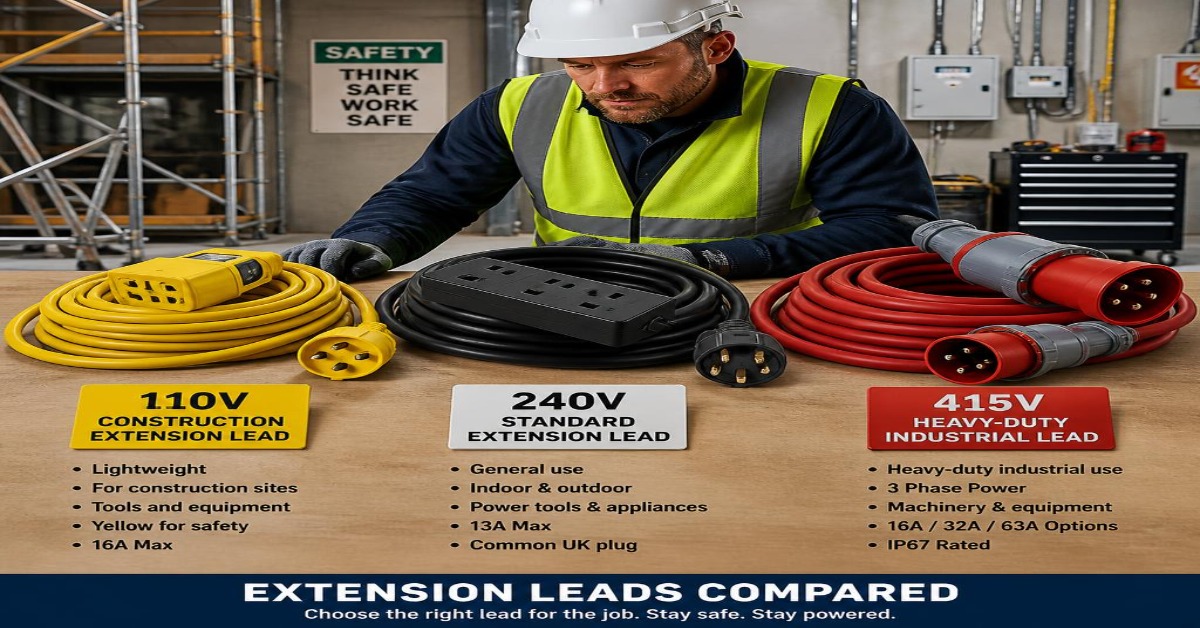
An extension lead is a portable cable that allows you to bring electrical power from a fixed source to your tools or equipment. In simple terms, it “extends” electricity so you can work further away from a socket. However, not all extension leads are the same, especially when it comes to voltage.
Understanding the difference between 110v extension leads, 240v extension leads, and 415v extension leads is essential because each one is designed for different environments and power demands. Choosing the wrong voltage can lead to equipment damage, inefficiency, or serious safety risks.
That’s why an extension lead voltage guide is important for anyone working in construction, industrial settings, or even large scale workshops.
Why Voltage Matters in Extension Leads
Voltage determines how much electrical power is delivered and how safely it can be used in different environments.
Using the correct system ensures:
- Safe operation of tools and machinery
- Reduced risk of electrical accidents
- Better performance of equipment
- Compliance with workplace safety standards
- Improved efficiency on site
This is especially important when working with industrial extension leads in demanding environments.
Common Issues from Using the Wrong Voltage
Many workplace accidents and equipment failures happen due to incorrect voltage selection:
- Using 240V tools in high risk construction areas without protection
- Overloading 110V systems with incompatible equipment
- Machinery underperforming due to incorrect power supply
- Electrical hazards caused by mismatched systems
- Increased downtime from tripping circuits or damaged leads
These problems often occur when users assume all extension leads function the same way.
Choosing the Right Voltage for Your Work
The solution is simple, match the voltage to your environment and equipment requirements.
1. Understand Your Work Environment
Different job sites require different voltage systems:
- Construction sites → usually 110V
- Domestic or light commercial use → 240V
- Heavy industrial machinery → 415V
2. Check Equipment Requirements
Always verify the voltage rating of your tools before connecting them.
3. Use Properly Rated Extension Leads
Each system is designed for specific loads and safety levels.
110V vs 240V vs 415V Extension Leads Comparison
| Feature | 110V Extension Leads | 240V Extension Leads | 415V Extension Leads |
| Typical Use | Construction sites | Homes, workshops, light trade use | Heavy industrial machinery |
| Safety Level | High (reduced shock risk) | Moderate | Requires trained handling |
| Power Output | Medium | Standard household power | Very high power delivery |
| Equipment Type | Power tools, site equipment | Appliances, light tools | Large industrial machines |
| Portability | High | High | Low (heavier duty systems) |
| Ideal Environment | Construction sites | Domestic & commercial use | Industrial factories |
Understanding Each Voltage Type
110V Extension Leads
110v extension leads are commonly used on construction sites. They are designed with safety in mind, reducing the risk of electric shock while still powering essential tools like drills, saws, and lighting systems.
240V Extension Leads
240v extension leads are standard in homes and light commercial environments. They offer more power but require greater caution in high-risk environments.
415V Extension Leads
415v extension leads are used in heavy industrial settings where large machinery requires high power loads. These systems are not typically used in general construction or domestic work.
Key Features of Industrial Extension Leads
When selecting industrial extension leads, consider the following:
- Heavy duty cable insulation for durability
- High load capacity suitable for demanding tools
- Reinforced plugs and sockets
- Safety protection such as RCD compatibility
- Weather resistant designs for outdoor use
Benefits of Choosing the Right Voltage
Selecting the correct extension lead voltage provides clear advantages:
- Improved safety across all working environments
- Better tool performance and efficiency
- Reduced risk of electrical faults or overheating
- Longer lifespan of cables and equipment
- Compliance with workplace safety regulations
Conclusion
Understanding the differences between 110v extension leads, 240v extension leads, and 415v extension leads is essential for safe and efficient power usage in any environment. By following a clear extension lead voltage guide, users can match the correct system to their tools and work conditions. Whether for construction, domestic use, or industrial applications, choosing the right industrial extension leads ensures safety, reliability, and optimal performance across all tasks.
FAQs
1. What is an extension lead?
An extension lead is a portable cable that extends electrical power from a fixed outlet to tools or equipment.
2. Why does voltage matter when choosing an extension lead?
Voltage affects safety, equipment compatibility, power delivery, and overall performance.
3. What are the main types of extension lead voltages?
The most common types are 110V, 240V, and 415V extension leads.
4. Where are 110V extension leads typically used?
They are mainly used on construction sites where enhanced electrical safety is required.
5. Why are 110V extension leads considered safer?
They reduce the risk of severe electric shock in high risk working environments.
6. What are 240V extension leads commonly used for?
They are widely used in homes, workshops, offices, and light commercial settings.
7. What applications require 415V extension leads?
They are designed for heavy industrial machinery and high power equipment.
8. Can any tool be used with any extension lead voltage?
No, tools should only be connected to extension leads that match their voltage requirements.
9. What problems can result from using the wrong voltage?
Incorrect voltage can cause equipment damage, poor performance, safety hazards, and downtime.
10. Which extension lead voltage is best for construction sites?
110V extension leads are generally preferred due to their higher safety level.
11. What is the advantage of 240V extension leads?
They provide standard household power and are suitable for many everyday electrical devices.
12. Why do 415V extension leads require trained handling?
They deliver very high power levels and are typically used in specialized industrial environments.
13. What features should industrial extension leads have?
They should include durable insulation, high load capacity, reinforced connectors, and weather resistance.
14. Why is RCD compatibility important for extension leads?
RCD protection helps reduce the risk of electric shock caused by electrical faults.
15. What are the benefits of choosing the correct extension lead voltage?
It improves safety, enhances equipment performance, reduces faults, and supports regulatory compliance.